Tuesday, 2 April 2013

Managing Learning?

classroomDonald Taylor recently published an article titled ‘What does ‘LMS’ mean today?’. In it Donald posited something I’ve been advocating for years.

It is this.

Learning can only be managed by the individual in whose head the learning is occurring.

Of course external factors – such as other people (especially your manager and your team), technology, prevailing culture, general ‘environmental’ factors, and a range of different elements – can support, facilitate, encourage, and help your learning occur faster, better, with greater impact and so on.  But they can’t manage the learning process for you. That’s down to you alone.

This raises an important set of challenges. One of which is “if learning is managed by the learner, what will the technologies that support her look like in the next 3, 5, 10 years?”

One thing we know for sure. They won’t look like the learning management systems installed in the vast majority of organisations across the world today. Sadly, many of these meet Marc Rosenberg’s description as ‘course vending machines’.

Keeping the CEO out of Jail

In his article Donald quotes Andy Wooler, Academy Technology Manager at Hitachi Data Systems Academy, as saying:

“LMS too often stands for Litigation Mitigation Service.”

Andy was not dismissing the need for LMSs out-of-hand. He was simply saying that often the technology is used just to keep records in case something goes wrong and there is a need to produce evidence to support the organisation’s case in court – or, hopefully to avoid court altogether.  Many organisations – especially those in highly regulated industries – take this view. In the past that strategy provided a more robust defence than it does now (see an earlier article about compliance training for a discussion on that issue). A record that someone had completed a compliance course may have won the day in the past, but is less likely to do so now. However, compliance course completion often has little, if anything, to do with learning and certainly won’t contribute much to building the high-performing cultures every organisation needs to aspire to if it’s to be successful.

A Tool for (a fading) Industrial Society

In his article, Donald also gave a pen-sketch of the origins of the Learning Management System (LMS) as training administration systems.

LMS technology emerged from a need to automate process management and record-keeping systems in the post-World War II era when the focus was on industrialisation and the development of mass production techniques. With millions of returned servicemen and women re-entering education and training there was a need to manage the process of classroom training more efficiently. LMSs appeared alongside the automation of other organisational processes – financial systems and HR management systems (HRMSs).

But LMSs were a step on the road, not an end in themselves.

The management modules of learning technologies such as PLATO (arguably the first LMS) the ‘computer assisted instruction system’ which was conceived and built at the University of Illinois in 1960 (and finally shut down in 2006) were developed to support automated teaching operations (the ‘ATO’ part of the name) in a world where standardisation and automation were the primary goal. They were conceived and developed to primarily solve an organisational problem, not necessarily to improve the learning experience for the individual learner or worker.

We need a lot more, and a lot different, from whichever technologies we select to support the development of our workforce today and into the future

Moving to the Future

The diagram below gives an idea of challenge facing us as we move into a world where learning management is in the hands of each individual and their supporting ecosystem.

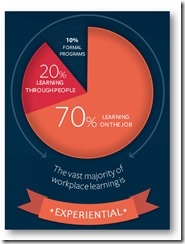
In a world where the majority of learning is in the workflow and most of it is ‘informal’ (self-directed or undirected in the moment of need), the idea of pouring large amounts of your organisation’s L&D budget into a concept and technology that was designed to make easier the scheduling of courses and programmes is not a sensible one to take.

Of course we will need technology to support learning. Even more so than ever before. But, as noted earlier, the technology we need is a long stride away from that which most organisations currently have in place.

LMS Evolution


My colleague Jane Hart has written about this challenge for some years (see here for an article by Jane from 2010). She sees the future of technologies supporting learning as a mash-up of social co-operation and collaboration tools aligned with the emerging social workplace. More importantly, Jane provides advice that L&D can’t sit alone.  Learning leaders need to work with their colleagues in IT and Business Operations to get the right tools in place. To that I’d add the need to work with Internal and Corporate Communications colleagues, Brand specialists, Knowledge Management teams as well as your extended value chain.

I think Jane is absolutely correct. The tools that will be used to support (but not manage) learning in the future will principally be drawn not from a learning-centric focus but from other area (although I believe the LMS will live on to support some formal education and may extend to a limited extent to supporting structured experiential learning). Her Top 100 Tools for Learning is probably a good place to start looking.

The Rise of PKM

My diagram above points to PKM (Personal Knowledge Management) as an important emerging area for supporting the learning-work interlink. Harold Jarche has written extensively on PKM and you can download his PKM Whitepaper from here.  If you want to learn more about PKM I’d recommend mining Harold’s blog.

There is no doubt that both social learning tools and PKM tools and processes will be vital to support learning management of the future.

However, it’s important to always remind ourselves that any technology can never be more than a supporting actor in the play of building high-performing cultures.

In the end we each manage our own learning to suit our immediate and longer-term needs at our own pace, in our own time, and in our own way.

--------------

(I have written more extensively about the challenge of ‘Managing Learning’ in the 'The Really Useful eLearning Instruction Manual' a book to be published by John Wiley & Sons and edited by Rob Hubbard)

#itashare

Thursday, 14 February 2013

Re-thinking Workplace Learning: extracting rather than adding

axesA decade ago the Corporate Executive Board published a report detailing the findings of a study into the role managers can play in employee development.

By almost any standards the sample in this study was large – 8,500 cases drawn from 14 organisations across six industries in nine countries.

One clear finding presented was that:

“those activities that are integrated into manager and employee workflow have the largest impact on employee performance, while those that are distinct events separate from the day-to-day job have less impact.”

In other words if people have the opportunity to learn and develop as part of their work and they are supported by their manager, then learning will be much better transformed into measurable behavioural change and performance improvement.

Context is Critical
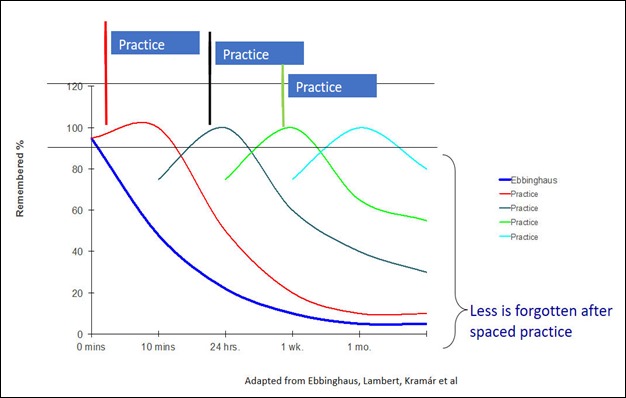
Although the Corporate Executive Board study is a good one, it didn’t tell us anything new about the importance of context for effective learning.  We’ve known about that for 120 years or more.  Certainly since Dr Ebbinghaus’ ‘remembering’ and ‘forgetting' experiments in the 1880s, and probably much longer.

Other studies have also produced similar results to this Corporate Executive Board work. The general finding is that the more tightly bound learning is to the workflow, the greater the impact it is likely to have.

Adding Learning to Work

addingMany learning professionals and training companies have taken the lesson about the criticality of context to heart and are designing courses and programmes that link learning with work more closely than was done in the past. 

Although this is a great improvement from the situation where the majority of learning activities were totally separated from work, it’s only a half-way house, if that.

The thinking is still principally about adding learning into work.

Jane Hart has observed a very similar trend with her study of the uptake of social learning. She noted (see her slides 10-21 here) that there’s a clear trend towards ‘social training’ in the professional learning and development and learning vendor communities (where social technologies are added to training events) rather than towards ‘social collaboration’ (where social technologies are used to support on-going knowledge sharing and collaborative working, and integrated with workflow).

In other words, Jane has observed that many learning professionals  link social technologies and activities to learning activities in order to support training outcomes – adding ‘social’ to learning – rather than facilitating and supporting social collaboration – where a social dimension is part of the workflow.

The latter is a whole new ball game for HR and learning professionals and involves extracting learning from work.

Extracting Learning from Work

extractingExtracting learning from work employs very different approaches to the additive form of workplace learning.

Firstly the focus is not on learning but on performance improvement from the outset.

It’s also not about requiring workers to adjust their working time and flow to include specific activities that have the explicit purpose of assisting learning.

It’s simply about developing approaches that help workers to learn more from their day-to-day work.

The impact of this latter approach is profound.

The Corporate Executive Board study found that if managers were more effective at providing workplace experiences that helped development, the impact on performance was an almost 20%1 uplift.

From this study, new and challenging workplace experiences were demonstrated to have almost three times greater impact on performance improvement than simply ensuring workers had the right knowledge and skills.

Similar results were found with the difference between ensuring that reflection occurred following the completion of a project or other piece of work, or just at regular intervals, and simply having the right knowledge and skills to do the job. there was found to be a 295% uplift in performance from reflective learning over ensuring the right knowledge and skills.

Impact on Flow and Measurement

flow

Approaching workplace learning in this way – by supporting the extraction of learning from work rather than the injection of learning activities into work – presents a whole new set of challenges for HR, Talent and L&D professionals.

the challenges include the facts that:

  • It can’t be built into a course or programme.
  • It can’t be ‘delivered’.
  • Managers need to be enabled and supported if it is to work.
  • It can’t be managed and controlled in the way discrete training and learning injections into the workflow can be.
  • most of the learning processes are opaque to HR and L&D and can only be made explicit through observation and other field survey and data collection approaches.

Also, the flow isn’t learning > work but a different and slightly more complicated work > learning > work. This ‘binds’ the learning more tightly into the workflow and any attempt to extract it ‘collapses the wave function’  (for explanation, see here).

So traditional attempts to ‘isolate’ the impact of learning becomes very difficult and we need to adopt more holistic types of analysis to determine what works and what doesn’t.

And it changes viable measurement approaches as well. The focus can no longer be on learning and learning metrics, but on performance and performance metrics. If we can’t measure intermediate steps (the ‘learning’) then we must focus on measuring the output (performance in the workplace) only. This is another new ball game for which HR and L&D must learn the rules (and there are rules).

New Opportunities

On the positive side, the ‘extracting learning’ approach opens up a new area of opportunity for L&D – beyond the module, course and programme and into the daily workflow as a mechanism for effective development, increased performance and greater productivity.

It’s there for the taking if we want.

-----------------------------

1 This figure is arrived at as a statistical estimate of the maximum impact on performance calculated by measuring predicted differences in employee performance between direct reports who rate their managers as least effective and those that rate their managers as most effective at supporting rich workplace experiences – such as challenging projects, stretch assignments, new project work etc.

#itashare

Wednesday, 16 January 2013

The Need to Adapt to the Speed of Change or Die: lessons for L&D from the retail industry

HMV

Yesterday another great British institution slid into the history books.

HMV opened its first retail shop in Oxford Street, London in 1921 with great brouhaha. Composer Edward Elgar took part in the opening ceremony. Yesterday, 91 years on, the company shut its shops and handed its administration over to Deloitte with the expectation that its assets will be sold where possible and the company laid to rest.

Music lovers spent many hours (or weeks) browsing HMV stores, which were part of the only ‘chain’ for music when I first came to England in the early 1970s. Richard Branson’s sole Virgin Records & Tapes shop along Bayswater Road in Notting Hill was always worth a visit (although it specialised in ‘krautrock’ – not one of my favourite genres) as were the other independents in Charing Cross Road, but HMV had the variety and the volume.

HMV’s demise has come at a time that is tough for the retail trade. The global economy is still depressed, and confidence amongst consumers still low. Alongside HMV, other British consumer stalwarts have failed in past weeks – Jessops, the camera chain (founded 1935); Blockbuster, the DVD and video rental chain (founded 1989); and Comet, the electrical retail chain (founded 1933). Along with these, the UK and Irish Virgin Music stores were sold in 2007 and went into administration in 2009.

logos

It seems that Deloitte and PwC are the only winners in a world where financial administrators are the current kings.

Lessons for L&D

I’ve been asking myself if there might be lessons for L&D departments here. I think there are.

A common strand runs through all of the above outcomes. It’s not just exposure to tough economic times and having to make changes to do more with less, and do things differently. Almost all individuals and enterprises are facing that.

Each of the above were overtaken by circumstances (and technologies) that changed faster and to a greater extent than they thought possible, understood, and planned for.

As with the many bookshops that have been forced to close in the face of new entrants to the publishing and distribution market – Amazon and Apple – the retail music industry certainly saw what digitisation was doing.  However, they didn’t grasp that it would create totally new distribution channels, new entrants from very different industries, and that it would disintermediate significant parts of the old value chain, side-line others, and build new markets that rendered old ones obsolete in the blink of an eye.

I was struck by the sheer blinkered view and ignorance of two ‘experts’ in the retail world as they analysed the demise of Jessops on BBC Radio 4 last week. One said “the real advantage of going to a store like Jessops was that you could speak to an expert who could advise on everything you might need to know about buying the right camera. You don’t get that when buying online”. The other agreed.

Have they never posted a question online? or read Amazon reviews? or joined something like photo.net and read the annual buyers guide, joined a forum or community and asked one of the tens of thousands of experts there for their freely-given advice?  Why would you put greater trust in someone who worked for a store with a vested interest not only in encouraging you to buy from them, but also to buy the products that gave them the highest return? Is it because you can see ‘the cut of their jib’ or you can assess their knowledge far better by looking them in the face? Does an expert look different to the rest of us? I think not.

Equally, I asked myself, why would people prefer to get information and learn through the intermediation of their L&D department if they have the alternative of doing so faster and more easily from other practitioners and colleagues, or people in their network who may or may not work in the same team, company or country as them? Especially if they can gain that knowledge and expertise without leaving their desk or workflow.

The answer, I believe, is ‘they wouldn’t’.

Some L&D professionals will counter with the challenge “how will you know that you have been given the right information and have been helped to learn the right things?”. The answer is that people will only know that through developing a level of trust in their sources of information and learning. And they will develop trust relationships by using the information, advice and expertise they’re provided with.  If they find it helps them get their work done better, faster or smarter then they’re more likely to ask again, and a competence trust relationship builds.

I don’t have the data to prove it, but I have a gut feeling that over time any one of us will build a network of trusted colleagues and advisors that will give us equally, if not better, information and advice for action than any traditional L&D department can possibly do – and certainly faster. Especially if we take the advice of Harold Jarche in thinking about the power of loose hierarchies and strong networks, and if our organisation actively encourages building a sharing, co-operative and collaborative culture of continuous learning.

What’s the point about this?

The point is that L&D departments need to adapt and do things differently, or do different things, if they are to remain relevant. Information dissemination (often the bulk of many training courses) doesn’t constitute the best use of time for specialists in building workforce knowledge and capability, nor for the intended recipients. L&D specialists should be focusing on understanding critical business problems that are being caused by underperformance and then working with stakeholders to design the best ways to solve them.  This may, or may not, involve designing, developing and delivering physical or virtual training, eLearning or some other intervention.

The Importance of Speed

I think Eric Schmidt made an excellent observation when he explained why Google’s interface is so simple – no ads, no clutter, just a query box, a banner (sometimes replaced by a ‘doodle’) and two buttons - ‘search’ and ‘I’m feeling lucky’ (I’ve yet to find anyone who regularly uses the latter).

Schmidt explained that the basic Google interface is designed in that way, and won’t change fundamentally, because people “will always use the easiest and fastest way possible to find information”. If they have difficult-to-navigate interfaces, or if anything gets in the way, then they will go elsewhere if they think there’s an easier option for them. First they ‘google’ it, then they ask someone nearby, call, message or email a trusted friend or colleague, phone a help desk, or read the manual (if there is one) – in that order. If Google created any obstacles, it would not be first choice.

There is a lesson in Schmidt’s advice for specialist learning technology interface designers, although it may come too late for some. Many organisations have wondered why employees look for ways not to use their Learning Management Systems and other learning technologies. Poor interface design is often the answer. I recall using one enterprise LMS that required 13 clicks of a mouse (some counter-intuitive) to register and launch an eLearning module. And we wondered why the generic eLearning library was under-used!

The point is that people need to work at speed, and anything that gets in the way will be bypassed or ignored. If an L&D department can’t respond at speed and deliver value it will be seen as a failure.

L&D Reinvention

ChangeHMV and the other failed institutions didn’t understand how rapidly and extremely their worlds were changing. By the time they did (if they did at all) it was too late.

L&D professionals need to take heed.

The world of learning and development has also changed. The same drivers are disrupting L&D as disrupted the music retail industry, and the camera sales industry, and the DVD rental industry, and the publishing industry, and the automotive industry, and the marketing industry, and the finance industry and countless other industries. People expect to be able to solve their problems with their performance quickly, and they expect to do so without leaving the workplace. They expect to manage their own career development, and build their own portfolios of experiences. They expect their employers to support them and provide resources to help, but they don’t expect their employer to ‘manage’ their learning and development from start to finish.

The lesson here for L&D professionals has been spelt out many times.

Most workforces are more like an orchestra than a battalion of soldiers. The role of L&D professionals needs to become more akin to a conductor (or even a page-turner for a pianist) than a sergeant-major. Expecting everyone to line up and follow the same instructions is a recipe for failure. We need to develop approaches and strategies to support organisational and individual goals in a much more nuanced way.

If there’s one lesson L&D needs to take from the failure of HMV and the others it is to fully grasp the speed and nature of the changes that are sweeping through most organisations – increased expectations of speed, relevance, and solutions that are just-in-time and not a minute late. Not only that, but also the increased expectation that L&D departments will deliver high value solutions to organisational challenges and help drive performance and productivity.

If an L&D department can’t make the internal changes needed and build the capability to do these things, then it deserves to follow HMV into oblivion.

#itashare

Monday, 7 January 2013

Internet Time Alliance Predictions for 2013

The Principals of the Internet Time Alliance decided to take a collective look ahead to the new year, and share our predictions. You’ll see overlap but also unique perspectives:
Charles Jennings
cj
An increasing number of organisations, independent of size, nature or location, will acknowledge that their traditional training and development models and processes are failing to live up to the expectations of their leaders and workforce in a dynamic and global marketplace. Some will take steps to use their financial and people resources and exploit new ways of working and learning. Others will be hamstrung with outdated skills, tools and technologies, and will be too slow to adapt. A confluence of technology and improved connectivity, increasing pressures for rapid solutions and better customer service, and demands for higher performance, will force the hands of many HRDs and CLOs to refocus from models of ‘extended formal training’ to place technology-enabled, workplace-focused and leader-led development approaches at the core of their provision. We will move a step or two closer to real-time performance support at the point of need.
Clark Quinn
cqWe’ll see an increasing use of mobile, and some organizations will recognize the platform that such devices provide to move the full suite of learning support (specifically performance support and informal learning) out to employees, dissolving the arbitrary boundaries between training and the full spectrum of possibilities. Others will try to cram courses onto phones, and continue to miss the bigger picture, increasing their irrelevance. Further, we’ll see more examples of the notion of a ‘performance ecosystem’ of resources aligned around individual needs and responsibilities, instead of organized around the providing silos. We’ll also see more interactive and engaging examples of experience design, and yet such innovative approaches will continue to be reserved for the foresightful, while most will continue in the hidebound status quo.  Finally, we’ll see small starts in thinking semantic use in technology coupled with sound ethnographic methods to start providing just such smart support, but the efforts will continue to be embryonic.
Harold Jarche
hjPeople who know nothing about connectivism or collaborative learning will profit from MOOC’s. Academics and instructional designers will tell anyone who wants to listen just how important formal training is, as it fades in relevance to both learners and businesses.The ITA will keep on questioning the status quo and show how work is learning and learning is the work in the network era – some will listen, many will not.

Jane Hart
Many traditional-thinking organisations will waste a lot of time and energy trying to track social interventions in the hope that they can control and manage “social learning”. Whilst those organisations who appreciate that social learning is a natural and continuous part of working, will acknowledge that the most appropriate approach they can take is simply to support it in the workplace – both technologically and in terms of modelling new collaborative behaviours. Meanwhile, we will continue to see individuals and teams bypass IT and T&D departments and solve their learning and performance problems more quickly and easily using their own devices to access online resources, tools and networks.
Jay Cross
jc2013 will be a great year. As William Gibson wrote, “The future’s already here. It’s just not evenly distributed yet.” The business world will become a bit more complex — and therefore more chaotic and unpredictable. Moore’s Law and exponential progress will continue to work their magic and speed things up. Learning will continue to converge with work. Increasingly, workers will learn their jobs by doing their jobs. The lessons of motivation (a la Dan Pink) and the importance of treating people like people will sink in. Smart companies will adopt radical management, putting the customer in charge and reorganizing work in small teams. Senior people will recognize that emotions drive people — and there are other emotions in addition to passion. Happy workers are more engaged, more productive, and more fulfilled. What’s not to like?
#itashare

Thursday, 3 January 2013

Determinism, Best Practice, and the ‘Training Solution’

clockworkDeterminism is the philosophical idea that every event, including every human decision and action, is the inevitable result of preceding actions and that, given certain conditions, there is only one outcome. Nothing else can happen.

Deterministic views of the world assume everything is a jigsaw puzzle rather then a chess game and that for every problem there is a single solution.

The logic follows that if this single solution can be identified, then all that’s required is for the series of steps to be described that lead to it and the outcome can be repeated at will.

Although determinism is part of our world, we shouldn’t assume that its principles can be applied everywhere. Anyone who has even the most rudimentary understanding of chess knows that to adopt a strategy based on determinism is to often invite failure.

The ‘Best Practice’ Conundrum

Dilbert

However, it seems that the majority of training and development approaches and processes are based on deterministic models.

We first need to identify best practice” is a cry often heard in HR and L&D departments as organisations set out on their journey to develop a high performing workforce.

“What’s wrong with that, then?” you may ask.

There’s absolutely nothing wrong with seeing how other organisations achieve their results and trying to learn from them.  But do not assume that if you do the same then your results will mirror theirs. That is simply bowing to determinism. Human behaviour and the nature of organisations both tend to be complex and highly variable, and neither lend themself to deterministic approaches.

Best practice is the result of deterministic behaviour and exists only in relatively simple systems.

If a chemical engineer is looking to design a new process or parameters for distillation in a chemical plant she may be able to identify the volumes and sequences that produce the highest amount of pure distillate. Others following an identical process will achieve identical results. This is the positive use of determinism – repeatable processes, identical results.

In more complicated and more complex systems there is no best practice, no single solution that can be transferred from one problem to solve the next without modification.

When we’re dealing with human and organisational learning and performance we’re dealing with highly complicated and complex systems. If we’re to learn from others we should be looking at good practice and novel practices that we can adopt and adapt and massage to work in our own specific context.

The point I am making is that we certainly need to learn from others on a continual basis, but don’t assume that if we find something working well elsewhere all we need to do is to follow the same ‘recipe’ to get the same results.

It’s Not Always Simple

I’d recommend that every HR, Talent and L&D professional make themselves familiar with Dave Snowden’s Cynefin framework if they are looking to better understand the important differences between learning and managing in simple, complicated, complex and chaotic systems. Cynefin is a sense-making model – where patterns emerge from the information and data – that explains how to respond to ordered and disordered systems.

Cynefin_framework_Feb_2011

The key point for HR, Talent and L&D professionals is that training is only appropriate in Simple and Complicated systems where cause and effect relationships exist, are discoverable, predictable and repeatable.

In other words, we can design, develop and deliver training to help people address future situations with the confidence that similar actions will produce similar results. Best practice exists only in simple working environments. Good practice (multiple good ways of achieving outcomes) exists in complicated working environments. In complex and chaotic environments (where most knowledge workers reside) traditional training and development approaches that are carried out away from the context of the workplace have little or no impact.

As such, Cynefin questions much of traditional management training and development.

Harold Jarche has been using the Cynefin model for some years to explain the nature of complexity. He offers some good guidance and potential strategies for working and learning in a complex world.

Together with Clark Quinn, Harold has also identified some of the challenges and opportunities created by complexity and how they can be addressed through employing the Coherent Organization Framework to understand and unpick the interrelations between work teams, communities of practice and social networks; define the differences between collaboration and co-operation; and explain how the interaction in the different contexts are synergistic.

Clark’s diagram here gives a clear view.

Jarche recommends coaching, mentoring, linking cognitive surplus with time surplus to solve real problems in the workplace, addressing difficult challenges, and building networks and communities. None of the recommendations include formal training.

This is an approach I have been focusing on for several years and why I have championed the 70:20:10 framework and established the 70:20:10 Forum to help organisations develop their people rather than train them.

Implications for Training

All of the above highlight some fundamental issues around the course/curriculum training model as the principal L&D tool in a complex world.

Where best practice can be defined it seems to make sense that the standard training and development model will work. Where good practice can be defined, training and development may also help by building better analytical capability and judgement. Beyond that, context is critical, complexity abounds and standard training and development approaches fail to have impact.

The issues are highlighted in the areas of management and leadership development. Despite huge budgets and huge amounts of time spent on designing, developing and delivering essentially away-from-work leadership training and development, we still have a situation where the overall quality of leadership is low, employee engagement is generally low and we are not innovating and exploiting our workforce potential nearly as well as we should be doing.

According to a survey undertaken by ORC International, a global customer research, employee engagement and financial services research firm, only 43% of UK workers believe that a positive relationship exists between staff and managers within their organisation. ORC also reports that just under half considered their company to be well-managed.

‘Engage for Success’, a UK Government-supported panel, estimates that the UK’s employee engagement deficit in 2012 to be costing £26bn in productivity each year.

Both of these data points tell us that something is broken.

But they also tell us that there is a great opportunity for improvement by adopting new approaches that will develop our workforce and, particularly, our leaders and managers, more effectively.

Development rather than Training

Mike Myatt identifies some of the important challenges around leadership development in a recent HBR blog article.

Myatt points out that “US businesses spend more than $170 Billion dollars on leadership-based curriculum, with the majority of those dollars being spent on Leadership Training”.

He goes on to say “Here’s the thing – when it comes to leadership, the training industry has been broken for years”.

Myatt touches on the limitations of the deterministic best practice issue in this way:

“When a trainer refers to something as “best practices” you can with great certitude rest assured that’s not the case. Training focuses on best practices, while development focuses on next practices”.

Myatt’s solution, like Jarche’s, is for organisations to create an environment where development occurs through mainly work rather than through training.  Myatt goes further and lists the limitations he sees as being offered by the ‘training solution’ and their alternative ‘development-focused’ perspectives.

Examples of the difference between ‘training’ and ‘development’ Myatt provides include:

4. Training focuses on the present – Development focuses on the future
5. Training adheres to standards – Development focuses on maximizing potential
6. Training is transactional – Development is transformational
8. Training focuses on the role – Development focuses on the person
10. Training maintains status quo – Development catalyzes innovation
12. Training encourages compliance – Development emphasizes performance

13. Training focuses on efficiency – Development focuses on effectiveness

14. Training focuses on problems - Development focuses on solutions

You may or may not agree with these binaries. They may represent extremes.  However I think Myatt is right. There are changes we need to make:

  • We need to address broken training models.
  • We need to get better at matching our people-development solutions to specific contexts.
  • We need to focus on equipping our workforce for the future, whatever that may hold, rather than trying to ‘fix’ them for the present.
  • We need to help our leaders, managers and workers to better exploit the learning opportunities in their daily workflow.
  • We need to ensure our HR, Talent, and L&D professionals develop their own skills and capability to help make all this happen.

-------

#itashare

Thursday, 27 December 2012

Exploiting The Link Between Employee Development & Customer Engagement

linkThis  post is adapted from a commentary written for the Spark Interactive / ClerkWell 2012 Digital Customer Experience Report – an annual industry report that focuses on customer engagement and how businesses are using digital means to build closer relationships and interact with their consumers.

You can download the report from the Spark Interactive website. It contains excellent data and analysis.

Customer engagement is directly linked to employee development.  If employees don’t understand how to delight their customers, then their organisations will almost certainly fail.

The role that learning and development professionals play in this process is critical. If they are to deliver value they must focus on the things that matter and use the best approaches possible to help their organisations delight customers.

------------------------------

Lessons from The Cluetrain

cover187-cluetrain-10th-0465018653 Back in 1999 the authors of The Cluetrain Manifesto posited the significant ways the Internet and associated technologies would transform all business activity. “Markets are conversations” they said, and “companies that assume online markets are the same markets that used to watch their ads on TV are kidding themselves”.

Equally, resilient companies understand that what constituted value in the past has changed significantly, too.

No-one would now argue that The Cluetrain Manifesto authors got it wrong. Speak to anyone across any number of industries – travel, consumer marketing, newspapers, finance and banking, and elsewhere – and you’ll hear how the new communication technologies have disintermediated the flow of information and changed the perception of value. What were once premium services can now be obtained or executed at the click of a button.

Intangible Trends

Twenty-five years ago intangible assets accounted for around one third of the valuation of U.S. companies. By the turn of the millennium more than 80 per cent of that value was intangible.

Value has migrated from property, plant and equipment to ideas, relationships, intellectual property and reputation. From assets created by people’s hands to asset held inside people’s head and hearts.

intangibles
source: ocean tomo

As times passes the importance of these intangible assets, particularly of relationships (rich social networks) and reputation (customer centricity) will only increase.

The Agility Imperative

The impact of these changes are manifest no more starkly than in workers’ ability to delight customers.

No longer can workers expect their employers’ formal learning and training approaches to meet their needs. The past world where development was ‘delivered’ in a way decided by learning professionals – packaged and inflexible – simply isn’t adequate for today’s fast-moving and always-changing world. The imperative for business agility and increased customer focus demands ‘learning at the speed of business’, and social networks and new communication channels are essential tools and conduits to achieve appropriate levels of responsiveness.

This increased rate of change and demand for agility doesn’t accommodate the rigidity and lag times of formal training and development. Workers today expect to drive their own development based on (ever changing) personal needs, and they expect to do it in the context of their work and together with their colleagues.

They also expect to manage their development in consort with their wider social networks – both within and outside their work. The loose ties with people outside our organisations provide insights that would never come from colleagues, so the value for organisations is significant, too.

However the answer is not simply ‘building relationships’. A recent Harvard Business Review article pointed out that customers don’t necessarily want ‘relationships’. What they want is help in making decisions. Deep down, every customer-facing worker also knows this. The single biggest driver of customer ‘stickiness’, by far, is decision simplicity.

All of these factors point to the need for new skillsets, new capabilities and new support approaches for staff in customer-facing roles, and there is no doubt that new social tools and approaches will be the bedrock. No organisation will escape the inexorability of the need to provide better customer experiences. Changing approaches to employee development are a critical element in that process.

David Weinberger, one of the authors of The Cluetrain Manifesto sums the situation up well:

“Your organization is becoming hyperlinked. Whether you like it or not. It’s bottom-up; it’s unstoppable.”

------------

The Cluetrain Manifesto by Chris Locke, Doc Searls, David Weinberger & Rick Levine http://www.cluetrain.com/

‘To Keep Your Customers, Keep It Simple’. Spenner & Freeman. HBR May 2012. http://hbr.org/2012/05/to-keep-your-customers-keep-it-simple/ar/1

-------

#itashare

Wednesday, 15 August 2012

Compliance Training: does it really work?

Sea Pool_1Until relatively recently I’d bought into the argument that organising regulatory and compliance training is one of the important and necessary tasks for an L&D department.

Virtually every organisation has regulatory and compliance requirements it needs to meet. In highly regulated industries even more so.

So it seemed sensible then that part of the obligation should fall on L&D to train employees to understand what’s expected of them to be compliant in their work.

However in light of experience I’ve come to ask myself whether compliance training has any real effect at all. Or is it mainly a waste of time, effort and the (vast amount) of money spent on it?

The answers I’ve found have been quite enlightening.

One way in which compliance training works

Compliance training undoubtedly works in one way. That is to ensure the right ‘boxes are ticked’ should something go awry.  Rather as support for the ‘we followed orders’ defence.  This is often the situation found in the wake of some non-compliant act that had led to an unwanted occurrence. The question as to whether the organisation has followed statutory or relevant professional body compliance training guidelines is often the first one raised.  Organisations produce their records of compliance training to be used as part of the defence.

In other words compliance training is useful as a back-stop to help avoid financial sanctions and, at worst, the CEO or Chairman ending up in front of a jury and possibly in prison (in the past a number have). Sometimes this ‘defensive compliance’ strategy works. Increasingly it doesn’t.

But does it actually improve compliance and lower the number of non-compliant acts?

The evidence

Certainly the evidence seems to indicate that the related domain of diversity training has little or no effect. Peter Bregman’s March 2012 article on the Harvard Business Review certainly states the case that diversity training doesn't extinguish prejudice. In fact, it promotes it. Bregman cites a study of 829 companies over 31 years that showed diversity training had "no positive effects in the average workplace."

If diversity training has no impact, or even negative impact, is compliance training in the same boat? If so, what are the alternatives?

A study by Yassi, Bryce, Maultsaid, Lauscher, and Zhao in the Canadian healthcare service showed that requiring completion of an online compliance module, rather than simply encouraging completion and allowing voluntary access, generated a higher intention to comply. So this might suggest that mandatory compliance training is a good thing.  But the difference was simply in the intention to comply, rather than compliance itself.

On the other hand Jeff Kaplan, a US lawyer and national expert in compliance and ethics, reports major problems with compliance training, especially online training. Kaplan found:

“An employee of a global company recently told me “In Europe, people pay their children to click through it” and at another company the phrase “mind numbing” was used to describe such training.  (Indeed, a lawyer whose full-time job had been developing on-line Compliance and Ethics training recently told me he doubted its efficacy.)   And, not infrequently, in-person training is criticized as well.”

Kaplan goes on to say:

“None of this should be surprising.  From a design perspective, training is often created in an utterly wholesale manner, so that, for instance, salespeople, those in finance and senior managers are all being given the same FCPA training even though their risks and responsibilities differ significantly.  Perhaps worse, from a deployment perspective, training is often disconnected from risk-causing events or other contexts in which Compliance & Ethics messages could be more effectively conveyed.”

There’s also another set of fundamental problems I’ll discuss below. But before getting into those, it’s worth thinking about environments where compliance is seen to be critical – in highly regulated industries.

Highly Regulated. Highly Compliant?

standard charteredEven in the recent past our press reports have been littered with highly regulated industries behaving in absolutely non-compliant ways on a huge scale. Just this week Standard Chartered Bank has agreed to pay a $340m fine for its alleged breaches of US sanctions that US regulators claimed left the financial system vulnerable to corrupt regimes and weapons and drug dealers. And there may be more sanctions and fines still to come for Standard Chartered.

BarclaysBefore Standard Chartered came Barclays (‘Barclays had a culture of gaming – and of gaming us’ said Andrew Bailey, the top banking regulator at the UK Financial Services Authority). Along with HSBC and others with their manipulation of the LIBOR rates. A damning report by the US Senate concluded that HSBC had a “pervasively polluted” culture, and that the bank’s Head of Compliance warned the CEO of non-compliant activities, but Lord Green, the then-CEO, took no action.

In July the economist David Blanchflower declared that in the wake of the interest rate fixing scandal “there are no longer any UK bankers who are credible candidates to become the next Governor of the Bank of England.

And it’s not just the banking industry.

There’s the Energy industry, with the disaster and fines encountered by BP and its sub-contractors in the Deepwater Horizon spill. The death of 11 men and extensive damage to marine and wildlife is simply another example of disasters resulting from non-compliance in what is supposed to be a highly regulated industry.

The report on the causes of the spill by the White House Oil Spill Commission blamed BP and its partners for making a series of cost-cutting decisions and the lack of a system to ensure well safety. The Commission also concluded the spill was not an isolated incident caused by "rogue industry or government officials", but that "the root causes are systemic and, absent significant reform in both industry practices and government policies, might well recur".

BP set up a $20billion compensation fund which has had more than one million claims to date, with more still coming in. 

The pharmaceutical industry, another one where regulation and compliance is held as paramount on every executives’ lips, has its share of high-impact non-compliance incidents. Just last month GlaxoSmithKline was instructed to pay $3bn in the largest healthcare fraud settlement in US history. GSK pleaded guilty to promoting drugs for unapproved uses and failing to report safety data to the Food and Drug Administration. Does GSK have a comprehensive programme of compliance training?  You bet it does.

The list of non-compliance incidents in highly regulated industries could go on almost ad infinitum.

Non-compliance is equally rife in not so regulated industries. It’s hardly worth starting on issues encountered in the media industry, in Mr Murdoch’s empire and elsewhere.

But what does all this tell us?

Just a waste of time, effort and money?

Actually, it tells us a lot. It gets to the heart of of what effective compliance training and approaches should be all about.

In his HBR article Jeff Kaplan reported a study that found the ‘decoupling of compliance training from sales activities’ in financial services firms was at the heart of many of the problems and was seen as having contributed to the misconduct at issue.

We need to step back from the standard knee-jerk response that compliance training is a necessary and effective way (and often the only way) of improving levels of compliance, and that there is no alternative open to us. There seems to be little evidence to support the link between compliant behaviour and current standard compliance training approaches. In fact some of the evidence indicates the contra-argument.

In other words it is likely that most of the time, effort and money spent on compliance training is simply being wasted. At best it’s a security blanket. At worst it promotes non-compliant behaviour. Even paper-waving training records in front of judges and national commissions no longer holds much sway.

Existing evidence points to a situation where most companies would be better off simply ditching their existing compliance training efforts wherever they can, and making mandatory training as fast and simple as possible. Maybe even encouraging the behaviours Jeff Kaplan reports above – getting children to click through the training to get a tick in the LMS box with as little thought and effort as possible.

So, is there a better way?

Effective compliance training

There is, and it involves something other than running endless compliance training courses.

First we need to start thinking about ways in which compliant behaviour is best encouraged.

The main objective for any organisational learning is to engender behaviour change. After all what is ‘learning’ if it isn’t changing and adapting behaviour to achieve different and, hopefully, better outcomes of action? Many seem to have forgotten this when they think about compliance challenges. When dealing with compliance training often the process becomes more important than the results, and training becomes the only club in the bag to deliver the process.

If training is to be used, it should be focused on changing behaviours. Testing short-term recall following some compliance training event won’t do that no matter what the regulatory bodies who define the ‘compliance curriculum’ say.  We need a different approach.

Compliance training needs to be top-down

There seems to be a common thread that runs through almost all high-profile compliance catastrophes. It is that the top-tier executives and middle managers in the organisations simply didn’t model the behaviours that would lead to a culture of compliance.

Take perceived value of employees. If you’re working in an organisation where the CEO is being paid many $millions and where the differential between top executive remuneration and bottom-tier worker pay is huge, why would you expect a culture of compliance to exist? Humans don’t work that way.

If you’re driven by extremely challenging targets and eye-watering potential rewards if you deliver value and profit for your organisation no matter what, why should your organisation expect you to be 100% compliant? If you can cut corners it’s likely that you will. Humans often work that way.

What about where employee treatment is differentiated on rigid hierarchical lines – where ‘masters of the universe’ rule, or where there is a culture of ‘it’s OK to say one thing and do another’? If people see their leaders as ‘different’ and disengaged from them they themselves are less likely to be engaged with the organisation. Less engaged workers are less likely to be compliant with standards and regulations.  That goes for senior as well as junior team members.

Organisations where leaders model the compliant behaviours they would like to see across the workforce are far more likely to display those behaviours across all levels.

Take the John Lewis Partnership in the UK, for example. This is an organisation that’s been built on the concept of fairness. ‘Never knowingly undersold’ is one credo that John Lewis has lived by since 1925. But behind that is a successful employee-owned business. More than 28% of stock ‘shrinkage’ in UK retail is due to internal theft – employees taking things. At John Lewis employees are ‘partners’ and own a share in the company. Even if you’re simply stacking the shelves you share a common goal with the company to safeguard profit. Low levels of internal theft are the result at John Lewis. Far below the average for the retail sector as a whole. I recall a John Lewis employee speaking about a colleague who had been discovered removing items from the Shepherd’s Bush, London, store. Her view was that the colleague was ‘stealing from us all’ and the policy of instant dismissal, with all shares and other benefits removed, should be enacted forthwith.  ‘We don’t do that stuff around here’ she said.

This view is common across the John Lewis partnership. Employees are engaged, so they value compliant behaviours, and will speak up when they see others being non-compliant. 

In the recent banking scandals, even senior managers didn’t speak up when they knew about non-compliant behaviour.  No amount of compliance training will change that. 

So where does this leave compliance training?

It certainly doesn’t mean compliance training isn't necessary at all. But it does mean that it’s likely to be far removed from the vast majority which currently exists, and that much of the future activity and focus to improve compliance won’t be through ‘training’.

Firstly, any formal compliance training should be led by senior managers and actively supported by executives. Not simply by leaders issuing homilies from afar, but by them ‘walking the walk’ and ‘talking the talk’. By modelling compliant behaviour themselves. By ensuring that everyone understands that employee fairness and ‘doing the right thing’ is at the core of their organisations. By ensuring that fairness is demonstrated across their workforces. Not by employees being told that’s the case, but by them seeing it with their own eyes.

Together with any formal training, at the top of every executive and manager’s priorities should be the encouragement and participation in awareness-raising about compliance and expected behaviours. If it isn’t then they shouldn’t be surprised to find non-compliance rife no matter how many compliance training programmes employees have been compelled to attend or complete.

The implications

As Ross Dawson points out in his ‘12 Themes for 2012’, reputations are more visible and vulnerable than ever before. We all know that. Reputations can and will be trashed in moments, especially with the increased pervasiveness of social media as a way for individuals to get a hearing. The era where the powerful controlled the distribution of information is well and truly over. Organisations large and small will increasingly have their innermost secrets washed in public.  Organisations that behave badly will be exposed. Compliant behaviour will become even more critical for survival for many organisations. And non-compliant behaviour will become ever more difficult to brush under the carpet.

So, we’d better get our approaches to compliance right. Some training may be needed, but it will never be sufficient.

To give Jeff Kaplan the last word on the training element:

What, then, will the future of Compliance & Ethics training and other communications look like?   Very possibly, the “same as it ever was” – because many companies simply do not push for excellence and innovation in Compliance & Ethics program matters (the way they do for corporate functions more traditionally seen as mission critical, such as sales).  Indeed, it is not only businesses actively engaged in bribery that pursue Compliance & Ethics “half measures.”

“But for organizations with a dynamic – and truly risk-focused – view of Compliance & Ethics programs, the path is clear: training should be developed in a far more granular way than it currently is and deployed when, where and how it can make the most difference.  After all, if Compliance & Ethics risks can evolve – which they do all the time – so can training.”